

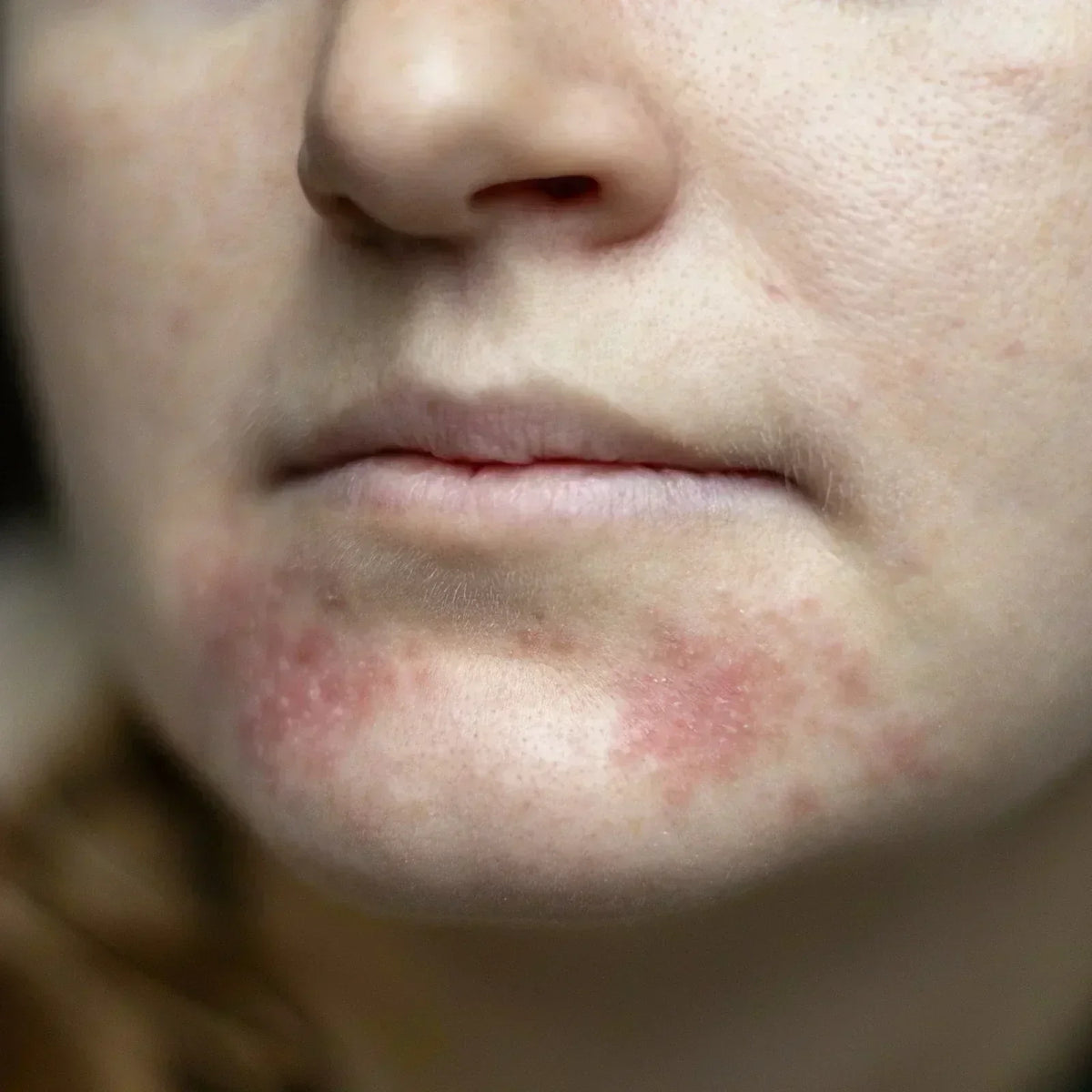
Perioral dermatitis: causes, symptoms and what really helps with perioral dermatitis
Redness and small pimples around the mouth? Anyone searching for these symptoms will quickly come across the term "perioral dermatitis" (Mundrose). It actually sounds quite pretty, doesn't it? For those affected, however, it is anything but rosy. In addition to redness and small papules, dry, flaky skin, a feeling of tightness, and unpleasant burning can be typical signs of perioral dermatitis. It is often said that the skin is simply "over-cared for." But is too much skincare really the cause of perioral dermatitis? It's not quite that simple. [7]
Research shows that several factors likely play a role in perioral dermatitis, making it difficult to identify a single trigger. A disturbed skin barrier seems to be just as important as inflammatory processes and various external triggers. [7]
In this article, you will learn how to recognize perioral dermatitis, what we know today about its development, and why, when it comes to perioral dermatitis, less skincare is actually more.
What is perioral dermatitis?
Perioral dermatitis, or POD for short, is an inflammatory skin condition that occurs primarily on the face. Since it does not exclusively affect the mouth area, the broader term periorificial dermatitis is also used in dermatology. [7]
It most commonly affects women between the ages of 18 and 45. However, perioral dermatitis can also occur in men and children. The rash most frequently develops around the mouth, but it can also spread around the nose and eyes as well as other areas of the face. The condition is generally chronic, with symptoms worsening in cycles. Perioral dermatitis is not contagious and is fundamentally treatable. [7]
However, perioral dermatitis cannot always be clearly distinguished from other skin conditions. Rosacea or hormonal acne, in particular, can look similar at first glance. Furthermore, hormonal acne often occurs in the same age range. Irritant or allergic contact dermatitis or seborrheic dermatitis can also be accompanied by symptoms similar to POD. Therefore, dermatological clarification is recommended for a persistent, long-lasting, or unclear rash. [7]