
Milia removal & prevention – causes and proper skincare

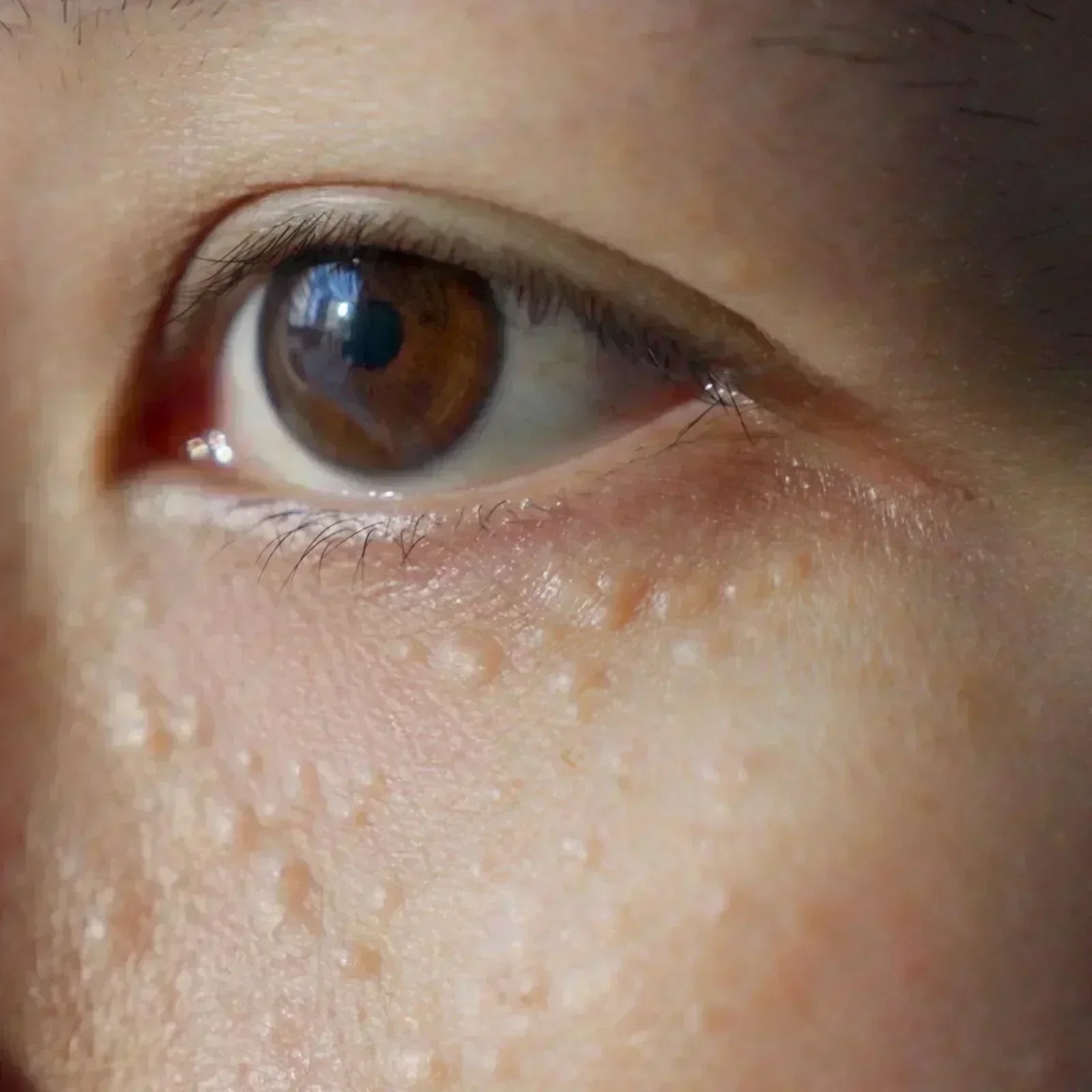
Milia, also known as millet seeds, are among the most common small skin changes on the face. These tiny white bumps most frequently appear around the eyes, on the cheeks, or on the temples. Although they are medically completely harmless, many people find them aesthetically bothersome.
Many affected individuals therefore wonder where milia actually come from and what skincare truly helps. In this article, you will learn exactly what milia are, how they form, and what skincare routine can be effective in reducing them long-term.
What are milia and what do they look like?
Milia, also known as millet seeds, are small, whitish to yellowish bumps that appear directly beneath the skin's surface. They are particularly common around the eyes, on the cheeks, or on the temples, and occasionally on other areas of the face. Medically, milia are considered harmless. They are neither inflamed, painful, nor itchy, but are often perceived as aesthetically bothersome.
Unlike whiteheads, milia are not clogged pores filled with sebum and bacteria, but rather small, subcutaneous keratin accumulations. They occur when dead skin cells are not shed normally but remain trapped under the outermost layer of skin. The cause is a disruption of the natural exfoliation process. Instead of detaching from the surface, the keratinized cells accumulate and form a small, firm, keratin-filled cyst.
Primary and secondary milia: What's the difference?
Primary milia appear spontaneously at any age without any direct identifiable reason. They typically occur in newborns or young adults. For example, they appear in about 50% of newborns.
Unlike primary milia, secondary milia do not occur spontaneously. They are preceded by specific skin damage, such as severe sunburn or other inflammatory or blistering processes. Histologically, they are small cavities filled with concentrically layered keratin lamellae, lined by a thin epithelial layer.
How do milia form?
Milia do not form because the skin is "dirty" or not cleansed thoroughly enough. They develop primarily when the natural exfoliation process is imbalanced, the skin barrier is weakened, and natural skin renewal is disrupted. If dead skin cells no longer detach evenly from the surface, keratin can become trapped beneath the skin, forming small retention cysts. However, the exact cause of their formation cannot always be clearly explained, and possible causes are diverse:
1. Barrier-weakening skincare and over-treated skin
A common, yet often underestimated, trigger is unsuitable skincare, especially products with classic emulsifiers. Emulsifiers combine oil and water in creams, but they can continue to act on the skin, dissolving the skin's own lipids from the protective barrier. If the lipid structure is weakened long-term, natural exfoliation also slows down.
Dead cells no longer detach evenly, and keratin can be more easily trapped.
Additionally, highly occlusive or comedogenic products, very rich eye creams, heavy night creams, or overall over-treated skin can permanently seal the surface. Especially in the sensitive eye area, thin skin reacts particularly quickly to an unstable barrier.
2. Genetic predisposition and hormonal influences
Some people are naturally predisposed to a thicker stratum corneum or slower exfoliation. Hormonal fluctuations, such as during puberty, the menstrual cycle, or after discontinuing hormonal contraception, can also influence keratinization. The skin then renews less evenly, which can promote the formation of milia.
3. Skin aging
As we age, cell renewal slows down. At the same time, the skin barrier often becomes more unstable. Dead cells are no longer shed as efficiently, allowing keratin to accumulate more easily. The overall skin appears more uneven and prone to small cysts.
4. Hormonal influences
Hormonal fluctuations, such as during puberty, the menstrual cycle, pregnancy, or after discontinuing hormonal contraception, can influence keratinization. Even though milia are not sebum-related, an altered skin physiology can promote their formation.
Removing milia: What to do if they don't disappear on their own?
With a bit of luck, these annoying bumps will heal on their own, which is often the case with newborns. An experienced aesthetician or dermatologist will lightly incise or laser milia under local anesthesia and then remove them, with the wound usually healing as a small red dot without problems.
However, neither primary nor secondary milia necessarily need to be surgically removed. With the right skincare, they usually disappear on their own.
Milia should never be squeezed by yourself. Unlike a pimple, there is no opening to the skin surface. Manipulation can lead to inflammation, infection, or permanent scarring.
What skincare helps with milia?
Unfortunately, there is no one-size-fits-all solution for milia. The crucial factor is not just that they are there, but understanding why they form. For milia that arise due to over-treated skin or slowed skin renewal, the right care can help get rid of these pesky keratin accumulations and bring the skin back into balance.
The right care for over-treated skin with milia
If you layer many products, regularly try new active ingredients, or use very rich care, your skin can quickly become overwhelmed. It then appears slightly caked, perhaps shiny, but at the same time uneven. In such cases, milia do not arise from a deficiency, but from an excess. Natural exfoliation gets out of balance because the skin can no longer function normally under occlusive layers, too many active ingredients, or continuous irritation.
Here, less care helps, not more.
It makes sense to consciously simplify your routine for two to four weeks. Temporarily pause active ingredients like bakuchiol or niacinamide, even if they are fundamentally good ingredients. In an over-treated phase, they additionally overwhelm the skin, even though they are supposed to help.
In the evening, the skin should still be thoroughly but gently cleansed. Especially if you wear sunscreen or makeup, double cleansing is useful because residues can additionally seal the surface. First, a cleansing oil dissolves oil-soluble residues like SPF and rich care. Afterward, a mild gel removes all emulsion residues, so no occlusive film remains on your skin.


Afterward, one of our light, barrier-strengthening DMS creams is recommended. The goal is not to apply as many lipids or fats as possible, but to stabilize the skin structure without further burdening it. Emulsifier-free, lamellar creams support the lipid structure of the skin barrier and help it to regenerate.
AHA and BHA Peels against Milia
If you prefer a minimalist routine and your skin doesn't feel "caked" or overly shiny, the problem usually lies in a slowed or uneven skin renewal process. Keratin-containing dead skin cells are not sufficiently shed, but instead remain trapped beneath the surface, forming small, firm, pearl-like nodules or cysts.
In this case, it makes sense to support skin renewal specifically and gently.
A mild, regular chemical exfoliation helps normalize shedding. For rather dry or thickened skin, our gentle AHA Peel is useful as it smooths the surface and regulates the stratum corneum. If your skin also has clogged pores or blackheads, a BHA Peel is more suitable, as it is oil-soluble and penetrates deeper into the pores.

Azelaic acid and Niacinamides against Milia
Additionally, our Azelaic Acid Serum is an optimal complement because it regulates keratinization, soothes, and balances the complexion. The Niacinamide Serum further supports by strengthening the barrier and improving skin renewal.
Double Cleansing for Deep Cleansing
Here too, double cleansing – consisting of our Deep Cleansing Oil and Deep Cleansing Gel – is useful in the evening, especially if you regularly use sunscreen.
Double Cleansing for Rosacea: If your skin tends to rosacea, you should not double cleanse too frequently and make sure to apply as little pressure and friction to the skin as possible.
Emulsifier-free face cream for skin barrier regeneration
Afterward, the skincare should always support the skin barrier and not further burden it. Our emulsifier-free DMS creams stabilize the skin structure, allowing the skin to renew more evenly again. A balanced skin barrier is the most important prerequisite for getting rid of milia in the long term.


❓ Frequently Asked Questions about Milia
Can I extract or remove milia myself?
No. Milia should under no circumstances be squeezed or scratched open by yourself. Unlike pimples, there is no opening to the skin's surface. Manipulation can cause inflammation, infection, or scarring.
How long do milia stay on the skin?
This varies. In newborns, milia usually disappear on their own. In adults, they can persist longer. They can either be cosmetically removed, but often recede with the right, skin barrier-strengthening care and gentle support of exfoliation.
What is the difference between milia and whiteheads?
Whiteheads are clogged pores that contain sebum and bacteria. Milia, on the other hand, are small, subcutaneous keratin accumulations and are not inflamed. Therefore, they cannot be extracted like a blackhead.
Do peels help against milia?
Mild, regular chemical peels help normalize natural exfoliation. For rather dry or thickened skin, AHA is suitable; for clogged pores or blackheads, our BHA peel. It is important not to over-irritate the skin.
Can rosacea promote milia?
With rosacea, the skin barrier is particularly sensitive and reactive. An unstable barrier can throw exfoliation out of balance and thus promote milia. In this case, a particularly gentle routine without too frequent peeling and without strong friction, even during double cleansing, is important.