Especially for mature skin, an important question arises: Is accelerated skin renewal always beneficial in the long term? Or is maintaining a stable skin barrier more important?
Mature skin, in particular, needs a stable barrier
When we talk about skin aging, we usually first think of visible changes such as wrinkles, loss of elasticity, or sagging skin. However, the aging process not only affects the skin's surface but occurs in all three skin layers: epidermis, dermis, and subcutis. Each of these layers changes in different ways, contributing to the appearance of aging skin.
The outermost skin layer, the stratum corneum, consists of flat, dead horny cells (corneocytes). These are embedded in a protective matrix of skin lipids and also connected by special cell junctions. Together, they form a stable skin barrier, ensuring that as little water as possible evaporates from the skin. At the same time, they protect against external stimuli and harmful substances.
With increasing age, cell renewal slows down. The skin becomes thinner, more sensitive, and less resilient. The composition of the skin's natural lipids also changes. At the same time, the skin's ability to repair barrier damage and restore its protective function decreases.[2]
In the dermis, both the number and activity of fibroblasts decrease. These are responsible for the production of elastin, collagen, and hyaluronic acid. As a result, the dermis loses its thickness and mechanical stability. The consequences are wrinkles, loss of elasticity, and increasingly sagging skin.[3]
In the subcutis (subcutaneous tissue), the distribution of subcutaneous fat tissue changes with increasing age. Especially in the face, the volume of certain fat pads decreases. Here, genetics plays a decisive role. Cosmetically, however, the epidermis and dermis are the primary targets to prevent premature skin aging and counteract visible signs of aging.[3]
Retinoids can weaken the skin barrier and increase moisture loss
Retinol can weaken the connections that hold our corneocytes together in the skin barrier. This causes corneocytes to detach from each other more quickly and be shed more intensely. A study also shows exactly this effect: in mice, 2% retinol led to larger gaps between corneocytes and changes in the stratum corneum.[1]
As a result, the skin barrier loses cohesion and its protective function is impaired. This makes the skin less able to retain moisture, and trans-epidermal water loss (TEWL) increases.[1][4]
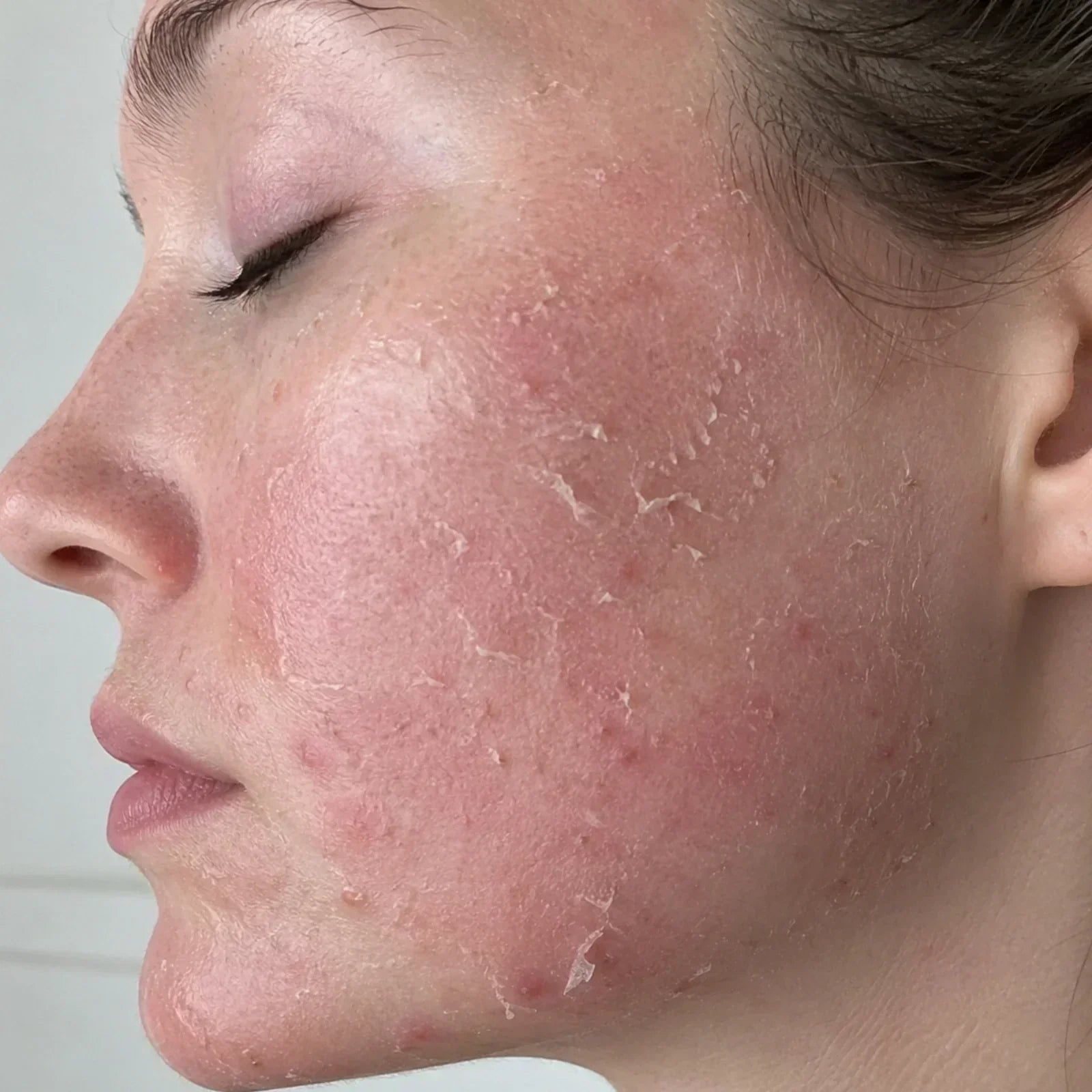
This aligns with the known negative side effects of retinoids such as dry, flaky, red, itchy, or burning skin.
Skin irritation from Retinol: Retinoid Dermatitis
Retinoid dermatitis, or skin irritation from retinol, is well-documented and not disputed. However, retinol proponents often argue that after an acclimatization phase, with correct dosage and not too frequent application, irritation no longer occurs.
However, a 2007 study showed that even after 24 weeks, the majority of subjects still experienced typical skin irritations from retinol. These included severe dryness, redness, flaking, and itching. And this was despite retinol being used very cautiously with up to three applications per week, and even temporarily paused in case of stronger irritation.[5]
What do we know about the long-term effects of retinol on the skin barrier?
The long-term effects of retinoids on wrinkles and photoaging are comparatively well-studied. However, what happens to the skin barrier in the long term is hardly investigated.
Studies show that retinol can affect various proteins that are essential for keratinization, skin barrier, and cell cohesion.[6] A one-year study observed changes in various epidermal proteins under retinol or retinoic acid – including proteins relevant for the structure and cohesion of skin cells.[6]
While this does not automatically imply that retinol permanently damages the skin barrier with every application, the results do show that retinoids interfere with fundamental biological processes in the epidermis in the long term. Especially for sensitive, dry, or already barrier-damaged skin, a careful consideration between desired effect and possible irritation is therefore advisable.
Retinol influences the maturation and desquamation of corneocytes. This can also alter structures important for the cohesion of corneocytes within the skin barrier. A study on mice with 2% retinol showed, among other things, larger gaps between corneocytes and structural changes in the stratum corneum.[1]
If the barrier function is impaired, the skin can retain water less effectively. Trans-epidermal water loss (TEWL) can therefore increase.[1][4] This matches the known side effects of retinoids: dryness, flaking, redness, itching, and burning are typical symptoms of irritated skin.
This aspect is particularly relevant for mature skin, as its ability to regenerate the skin barrier is already reduced. An active ingredient that, on the one hand, works against signs of skin aging, but on the other hand can additionally stress the already more vulnerable barrier, should therefore be considered in a differentiated way.
Our approach: Sustainable slow aging requires a healthy skin barrier
We do not just view skin aging as a consequence of reduced collagen and decreased skin firmness. For healthy and resilient skin, both the outer skin layer with its protective skin barrier and the deeper dermis with its supporting tissue are crucial.
Therefore, at myrto, we pursue a different approach: We specifically use active ingredients that slow down skin aging without unnecessarily irritating the skin barrier. Because it's not just about how good our skin looks today or tomorrow, but also how healthy and resilient it will be in 1, 2, or 5 years. Truly sustainable slow aging can only be achieved with an intact barrier protection and skin that can retain its moisture.
This includes active ingredients such as Bakuchiol , Signal Peptides , Barrier Lipids, and Antioxidants.
Our facial care is therefore consciously designed for long-term support of the skin barrier. Instead of aiming for the strongest possible short-term reactions, we focus on the balance between high efficacy and optimal tolerability – with an intact skin barrier that retains moisture and reliably fulfills its natural protective function.
Conclusion: Is retinol harmful?
They influence keratinization, loosen the cohesion of corneocytes, and alter structures that are crucial for an intact skin barrier.[1][4][6]
Especially for mature, dry, sensitive, or already barrier-damaged skin, therefore, accelerated skin renewal should not be the sole focus. A stable skin barrier is an important prerequisite for the skin to retain moisture and fulfill its natural protective function.
Sustainable slow aging for us therefore does not mean maximum active ingredient intensity, but a long-term balance between effectiveness, tolerability, and a healthy skin barrier.
Our Well Aging Products
Frequently Asked Questions about Retinol and Skin Barrier
Is retinol harmful to the skin?
In addition to the known side effects of retinol, such as itching, redness, or flaking, retinol interferes with the structure of the stratum corneum. It can damage the cohesion of the corneocytes and thus impair the skin barrier. The result is increased moisture loss: the skin becomes drier, more sensitive, and more prone to irritation. Long-term use has also shown persistent changes in barrier-critical structures and proteins.
Why is retinol concerning?
Retinol deeply interferes with the renewal and differentiation processes of the epidermis. It can alter the structure of the stratum corneum, loosen the cohesion of the corneocytes, and thus weaken the natural barrier function. The consequences can be increased moisture loss, dryness, flaking, redness, and persistent irritation. With excessive intake of vitamin A, there is also a general risk of accumulation in the body.
What side effects can retinol have?
Typical side effects of retinoids include dry skin, flaking, redness, burning, and itching. These skin reactions are often referred to as retinoid dermatitis. Studies show that such irritations can persist even with moderate use over a longer period.
Why is retinol problematic for mature skin?
With increasing age, the skin barrier regenerates more slowly and has difficulty retaining moisture. Retinol additionally stresses this already more sensitive barrier and can exacerbate dryness, flaking, and irritation. Especially for dry, sensitive, or barrier-compromised mature skin, a barrier-oriented well-aging skincare is therefore the gentler alternative.
What happens with long-term use of retinol?
Even with long-term use, retinol can continue to stress the skin barrier. Studies show persistent skin irritations and changes in proteins relevant for keratinization, cell cohesion, and the skin barrier. An impaired barrier also loses more moisture, making the skin drier and more sensitive. The effects of years of retinol use on the skin barrier have so far been insufficiently investigated.
What is an alternative to retinol for sensitive skin?
Bakuchiol is a well-researched plant-based alternative to retinol. Studies show an effect against wrinkles and hyperpigmentation with better skin tolerability than retinol. Additionally, signal peptides such as Matrixyl are suitable, which specifically support age-relevant skin processes without irritating the skin barrier like retinoids.
Is Bakuchiol an alternative to Retinol?
Yes, bakuchiol is a well-researched plant-based alternative to retinol and is particularly suitable for sensitive and mature skin. Studies show positive effects on wrinkles and hyperpigmentation with better skin tolerability. Unlike retinol, bakuchiol causes significantly less dryness, flaking, and irritation, making it particularly suitable for gentle, barrier-oriented well-aging care.
What is the downside of retinol?
Retinol can severely irritate the skin and weaken the skin barrier. It affects the structure of the stratum corneum by loosening the cohesion of corneocytes and promoting their desquamation. This can make the barrier more permeable, increase moisture loss, and make the skin drier and more sensitive. Typical consequences are dryness, flaking, redness, burning, and itching, which can persist even with prolonged use.
Sources
[1] Kim MY, Lee SE, Chang JY, Kim SC. Retinoid Induces the Degradation of Corneodesmosomes and Downregulation of Corneodesmosomal Cadherins: Implications on the Mechanism of Retinoid induced Desquamation. Ann Dermatol. 2011;23(4):439–447. doi:10.5021/ad.2011.23.4.439.
[2] Ghadially R, Brown BE, Sequeira Martin SM, Feingold KR, Elias PM. The aged epidermal permeability barrier. Structural, functional, and lipid biochemical abnormalities in humans and a senescent murine model. J Clin Invest. 1995;95(5):2281–2290. doi:10.1172/JCI117919.
[3] Zouboulis CC, Makrantonaki E. Clinical aspects and molecular diagnostics of skin aging. Clin Dermatol. 2011;29(1):3–14. doi:10.1016/j.clindermatol.2010.07.001.
[4] Elias PM, Fritsch PO, Lampe M, et al. Retinoid effects on epidermal structure, differentiation, and permeability. Lab Invest. 1981;44(6):531–540. PMID: 6939940.
[5] Kafi R, Kwak HSR, Schumacher WE, et al. Improvement of Naturally Aged Skin With Vitamin A (Retinol). Arch Dermatol. 2007;143(5):606–612. doi:10.1001/archderm.143.5.606.
[6] Abed K, Foucher A, Bernard D, Tancrède Bohin E, Cavusoglu N. One year longitudinal study of the stratum corneum proteome of retinol and all trans retinoic acid treated human skin: an orchestrated molecular event. Sci Rep. 2023;13:11196. doi:10.1038/s41598-023-37750-5.