
Skincare in Menopause: Dryness, Wrinkles & Blemishes and Why the Skin Barrier Is Now Important
Customers often write to us that their skin suddenly changes completely during menopause. The skin becomes drier and more sensitive, wrinkles or pigment spots become more visible, and at the same time, pimples or oilier skin suddenly reappear. Even skincare products that worked perfectly for years are suddenly no longer tolerated.
But why does skin change so much during menopause? What do estrogen and other hormones have to do with it? And how should skincare adapt to these new needs?
The main reason lies in hormonal changes. In particular, declining estrogen levels affect our skin's moisture supply, collagen production, skin barrier, and regeneration. In this article, you will learn what happens to the skin during menopause and what really matters for your skincare now.
What changes during menopause?
Menopause is a natural phase in every woman's life where hormone levels change. The ovaries increasingly produce fewer sex hormones, especially estrogen and progesterone.
These hormones not only affect our cycle but also our skin. For the skin, the declining estrogen level is particularly significant. Estrogen supports various processes that keep our skin firm, elastic, and well-hydrated.
The skin loses collagen and elasticity
Estrogen, among other things, influences our fibroblasts. These are cells in the skin's connective tissue that produce important structural components like collagen. You can simply imagine collagen as a kind of scaffolding for our skin. It ensures that it remains firm and taut.
As our estrogen levels decrease, so does the skin's collagen content. According to studies, the skin can lose up to about 30% of its collagen within the first five years after menopause. The skin becomes thinner, loses elasticity, and wrinkles can become more visible. [1]
The skin becomes drier
Estrogen also influences how well our skin can retain moisture. Among other things, the skin's own hyaluronic acid plays a role in this, binding water in the skin and making it appear plumper.
With declining estrogen levels, the skin's moisture content often decreases as well. At the same time, sebum production and natural skin lipids can change. As a result, the skin often feels dry, rough, or taut. [1]
The skin barrier becomes more sensitive
Our natural skin barrier also changes. You can imagine it like a wall: the corneocytes of the outermost skin layer—the epidermis—form the bricks. In between are skin's own fats like ceramides and cholesterol, which act as lipid mortar holding everything together. This protective layer ensures that moisture stays in the skin for a long time and simultaneously protects it from external irritants.
During and after menopause, the composition of these skin lipids also changes. In one study, the skin of postmenopausal women contained fewer ceramides than that of premenopausal women. Ceramides are particularly important for a stable skin barrier and moisture retention. [2]
In addition, our skin regenerates more slowly with age. Declining estrogen levels also play a role, as estrogen influences skin cell renewal and various repair processes. Studies, for example, show delayed wound healing in cases of estrogen deficiency. Therefore, irritations may take longer to subside. [3]
Why can pimples still appear during menopause?
Although many women experience drier skin, others may suddenly develop blemishes again.
Hormonal changes also play a role here. While estrogen significantly decreases, the ratio to male sex hormones, known as androgens, changes. This includes testosterone, for example. Androgens can therefore become relatively more prominent and promote blemishes or oilier skin in some women. [4]
Therefore, there is no single typical menopausal skin type. Some women develop very dry and sensitive skin, others struggle with blemishes, and still others notice hardly any changes.
What skin changes can occur during menopause?
Due to the interplay of hormonal changes and natural skin aging, very different changes can occur:
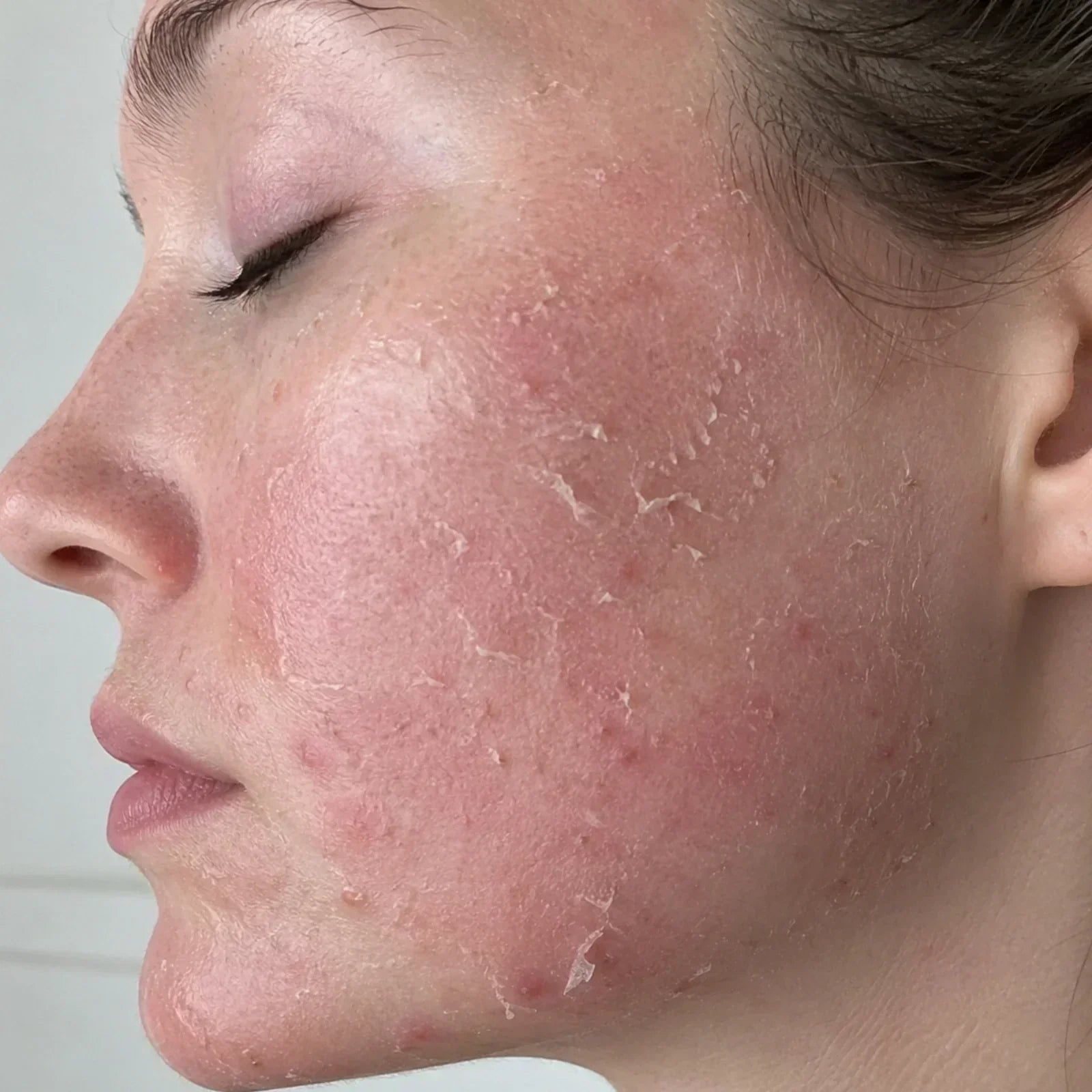
Dry and sensitive skin: The skin can store less moisture and produce less sebum. Feelings of tightness, flaking, itching, and increased sensitivity can be the result. [1]
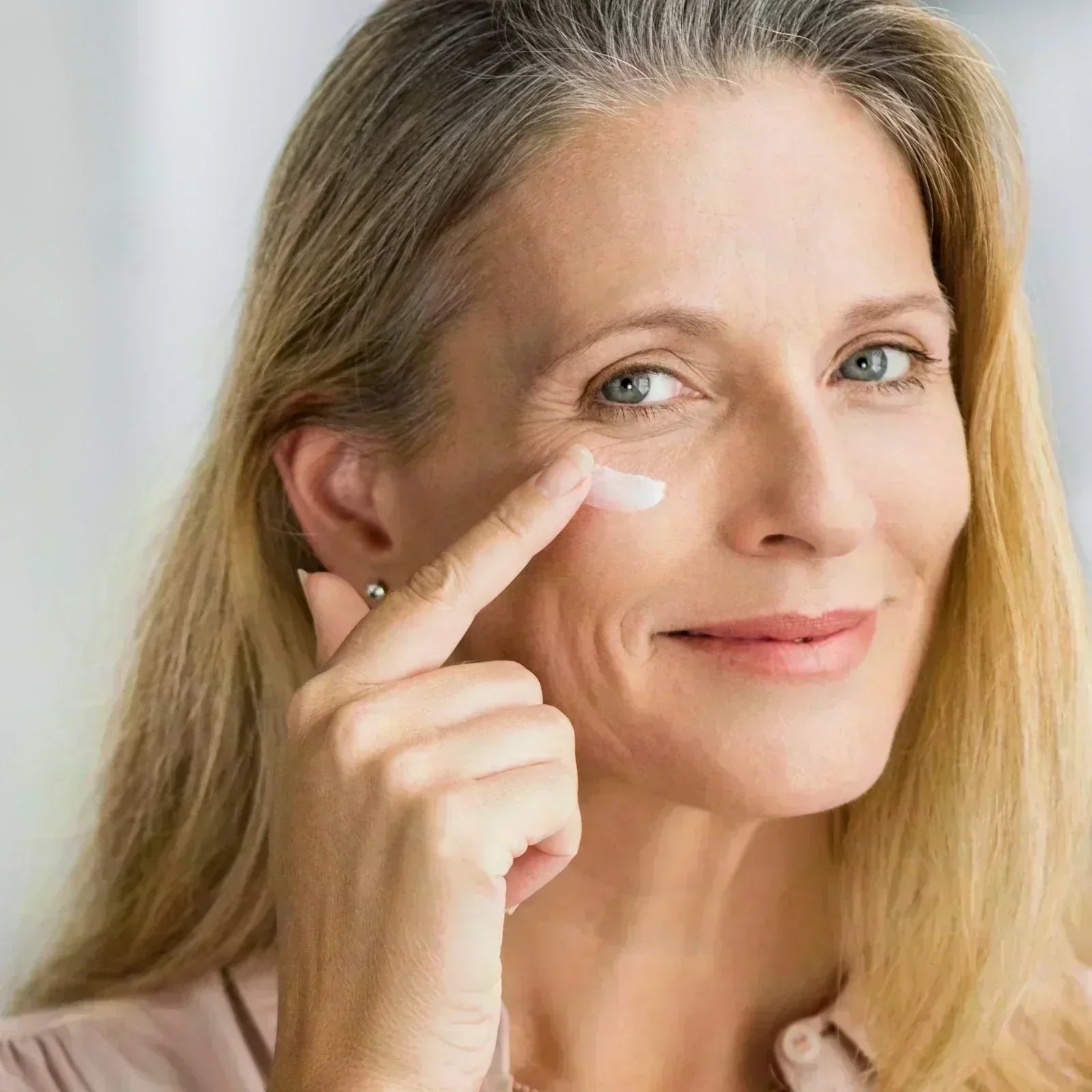
Slackening skin and wrinkles: Due to the loss of collagen and changes in skin structure, elasticity decreases. Wrinkles and less firm facial contours become more visible. [1]
Blemishes and oilier skin: The altered ratio of sex hormones can promote blemishes in some women. [4]
Rosacea and redness: The connection between menopause and rosacea is not clear. Hot flashes and the associated strong facial flushing can, however, exacerbate existing rosacea symptoms. [4]
Neurodermatitis and itching: Dry and sensitive skin can further complicate existing skin problems. Severe or newly occurring symptoms should be clarified dermatologically.
Pigment spots: With increasing age, the effects of years of accumulated UV exposure also become more visible. Hormonal changes can also influence pigmentation. [4]
Why your previous skincare suddenly stops working
When the skin can store less moisture, its lipid supply changes, it becomes more sensitive, and regenerates more slowly, its demands on skincare products also change.
A cream with conventional emulsifiers that was previously well tolerated can further burden increasingly sensitive skin. A study shows that emulsifiers can accumulate in the stratum corneum and bind to the skin's own lipids there. Upon contact with water, these skin's own lipids are washed out of the skin. [5] This so-called "washout effect" further weakens the protective function of the skin barrier.
A foaming cleanser that was previously well tolerated suddenly causes feelings of tightness. At the same time, trying to treat wrinkles with aggressive ingredients like retinol or highly concentrated acids can further irritate already sensitive skin. Especially when the natural skin barrier is weakened and its regeneration slows down, anti-aging should not come at the expense of a healthy skin barrier. Therefore, your skincare should not be based solely on your age, but on the current condition of your skin. A 55-year-old woman may still have rather oily or blemish-prone skin, while another of the same age suffers from pronounced dryness. The care should be correspondingly different.
Anti-Aging Ingredients and Skin Barrier

When the skin loses collagen and elasticity, it initially seems obvious to use particularly intensive anti-aging ingredients. However, especially during menopause, it is important to strengthen the skin barrier. If the skin barrier is weakened, the skin loses moisture more easily and is less protected from external influences. Wrinkles become visible more quickly.
For this reason, we view retinoids critically: Although they can reduce wrinkles in the short term, they can also exacerbate the very skin problems that many women already struggle with during menopause: dryness, redness, burning, flaking, and an irritated skin barrier. [6] Precisely because the skin becomes drier, more sensitive, and less regenerative due to declining estrogen levels, it makes no sense to regularly irritate it with aggressive ingredients like retinoids.
A gentler alternative is bakuchiol. This plant-based active ingredient can also improve signs of skin aging such as wrinkles and pigment spots. However, it is much better tolerated and does not attack the skin barrier. In one study, bakuchiol and retinol showed comparable improvements in wrinkles and hyperpigmentation. However, flaking and skin burning occurred more frequently with retinol. [7]
For us, healthy skin aging therefore does not mean reducing wrinkles at all costs. Much more important is to keep the skin healthy and resilient in the long term, to strengthen its natural skin barrier, and to support its regeneration.
What does skin need during menopause?
1. Gentle Cleansing
The drier and more sensitive the skin becomes, the more important gentle cleansing is. It should remove dirt, sebum, makeup, and sunscreen without overly degreasing the skin. Aggressive surfactants, frequent washing, and very hot water can further stress dry and sensitive skin. Therefore, we recommend a mild cleansing gel only for oily skin; otherwise, we recommend our emulsifier-free, surfactant-free cleansing creams.
2. Moisture
Moisture-binding active ingredients help the skin to store water. These include, for example, glycerin, hyaluronic acid, and beta-glucan. Especially when the skin appears increasingly dry and less plump during menopause, good hydration should be an integral part of daily care, for example with our Hyaluron Serum or a Peptide Serum with Hyaluron.
3. Support Collagen Production
With declining estrogen levels, the skin's collagen content also decreases. In addition to barrier-strengthening care, ingredients that support the body's own collagen production can therefore be beneficial.
Bakuchiol and peptides are particularly interesting for this. Bakuchiol can stimulate collagen production and simultaneously counteract pigment spots and impurities. Our Organic Bakuchiol Oil Serum combines 1% bakuchiol with nourishing squalane, organic grapeseed oil, vitamin E, and astaxanthin. Our Peptide Collagen Serum, on the other hand, relies on a 3.5% peptide complex of biomimetic peptides, supplemented with paracress, oat peptides, and hyaluronic acid. It specifically supports collagen and elastin formation and is suitable as a lightweight serum for all skin types.


4. Skin Lipids
Moisture alone is often not enough for dry menopausal skin. Our skin's natural fats are an important component of the skin barrier. Suitable facial care should therefore provide both moisture and appropriate lipids or fats for dry and lipid-deficient skin.
5. Antioxidant Protection

UV radiation and other external stressors create so-called free radicals in our skin. These can damage cells and important skin structures. Declining estrogen levels are also associated with reduced resistance to oxidative stress. [1]
Antioxidants like vitamin C and various plant-based active ingredients can help neutralize free radicals.
6. UV Protection
UV radiation promotes collagen breakdown and contributes long-term to wrinkles, loss of elasticity, and pigmentation changes. Consistent UV protection should therefore be an integral part of morning facial care during and after menopause. [8] Our Sunshine Day Oils offer natural sun protection without chemical additives for daily use. For intense sun exposure, mineral sunscreen is recommended for added protection.
Facial Care in Menopause: Why the Skin Barrier is Particularly Important Now
The drier and more sensitive the skin becomes, and the slower its regeneration, the more important an intact skin barrier becomes.
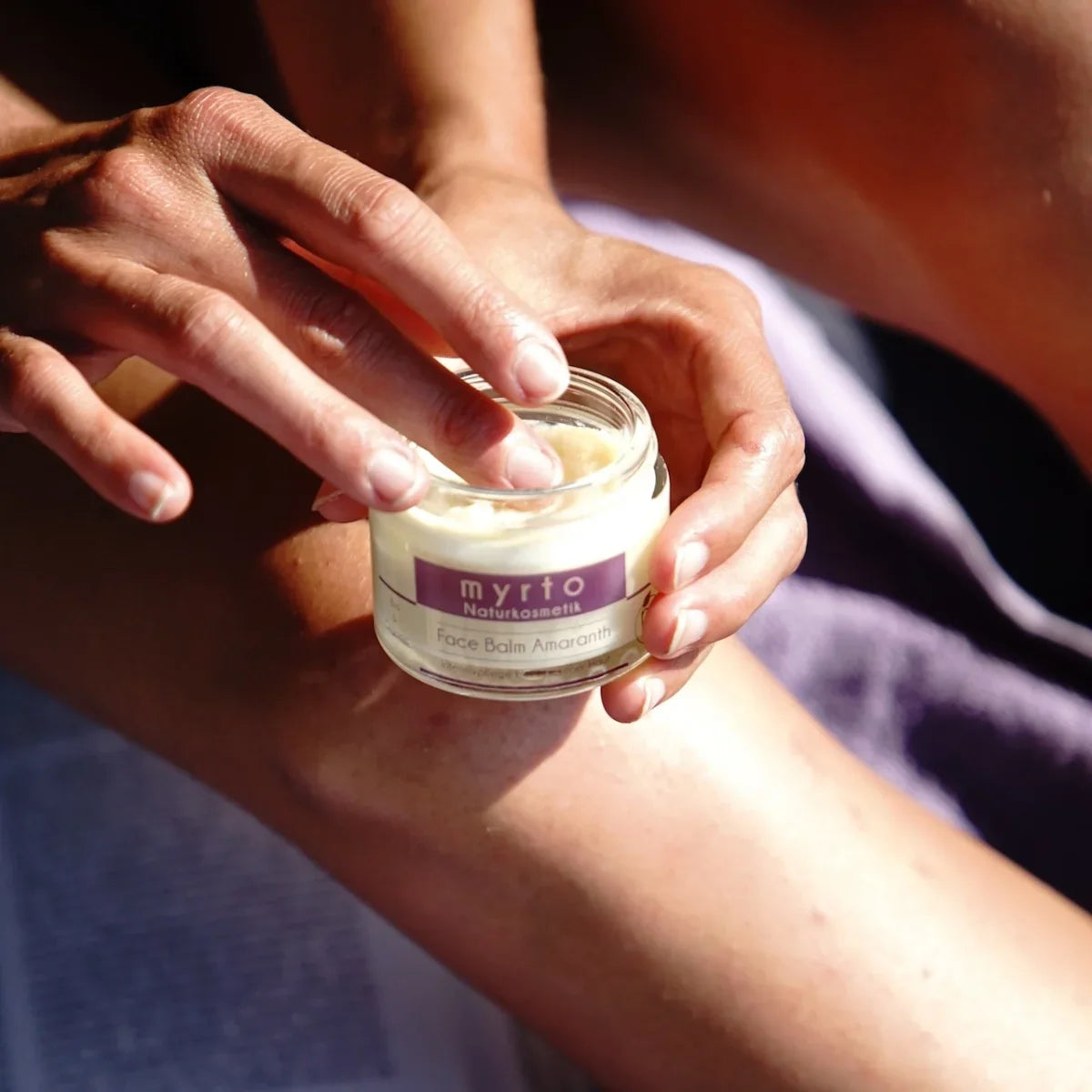
This is precisely where our myrto facial care comes in. Instead of confronting the skin with as many intensive active ingredients as possible, we pursue a low-irritation approach that focuses on its natural protective function.
Our facial care does not contain alcohol, fragrances, or conventional emulsifiers.
Skin-Related Lipid Structures Instead of Conventional Emulsifiers
In our emulsifier-free membrane structure creams, we use plant-based phosphatidylcholine. This sounds complicated at first, but it is a substance that is an essential component of human cell membranes.
Phosphatidylcholine has a lamellar structure. Simply put, this means that the lipids arrange themselves in several thin layers, similar to the fats (lipids) within our natural skin barrier. In our creams, we use these skin-related structures instead of conventional emulsifiers.
Additionally, we use natural fruit fibers from pectin. They hold the oily and watery components of our creams together like a fine mesh. On the skin, pectin forms a thin, breathable film, thus supporting moisture retention.
Beta Glucan for Moisture and Sensitive Skin
Another important component of our creams is beta-glucan from oats. It has moisture-binding and soothing properties and supports the natural skin barrier.
Especially during menopause, our approach is therefore not "more active ingredients at any cost." Targeted active ingredients and emulsifier-free formulations support the skin's natural protective and regenerative functions instead of weakening them.
Which facial care suits my skin type?
Even during menopause, there isn't one single correct facial care. What matters is how your skin has actually changed.
Dry Skin
For dry skin with a feeling of tightness, care should combine moisture and sufficient lipids. A mild, surfactant-free cleanser, a moisturizing serum such as a Hyaluron Serum or a collagen-stimulating Peptide Serum and a richer cream support the skin during this phase.
Oily Skin
Skin can also be oily during menopause. In this case, it doesn't make sense to reach for a particularly rich "anti-aging cream for over 50s" solely based on age. A lighter, moisturizing care is more suitable then.
Blemish-prone Skin
When blemishes occur more frequently, there is often an impulse to cleanse the skin particularly thoroughly and dry it out. However, especially with skin that is simultaneously becoming more sensitive, this further stresses the skin barrier. More sensible options include a mild cleanser, targeted active ingredients against blemishes such as Copaiba or Azelaic Acid, and a light, barrier-strengthening care.
Typical Skincare Mistakes During Menopause
Overly aggressive cleansing: Strongly degreasing products with aggressive surfactants can further burden dry and sensitive skin.
Too many intensive active ingredients: Using retinoids, acids, and other highly active ingredients simultaneously can unnecessarily irritate sensitive skin.
Automatically using rich skincare for all skin over 50: Even during menopause, there can be combination, oily, and blemish-prone skin. Skincare should match the skin condition, not just the age.
Focusing only on moisture: Dry skin often needs not only moisture but also sufficient lipid supply.
Confusing irritation with effectiveness: Burning, severe redness, or flaking are not necessary proof that a product is particularly effective. Especially with retinoids, such irritations can occur even with prolonged use. Instead of further stressing the skin with highly irritating active ingredients, we rely on skin-friendlier anti-aging active ingredients such as Bakuchiol as a plant-based retinol alternative or Peptides to support collagen formation.
Conclusion: During menopause, your skin doesn't necessarily need more care, but more barrier protection.
Decreasing estrogen levels change our skin on several levels. It can lose collagen and elasticity, become drier and more sensitive, and regenerate more slowly. At the same time, some women may experience blemishes or oilier skin.
The answer to this is not necessarily a comprehensive anti-aging routine. Mild cleansing, sufficient moisture and lipids, specifically selected active ingredients, antioxidant protection, and consistent UV protection form a good foundation.
Special attention should be paid to the skin barrier. For us, healthy skin aging does not only mean reducing wrinkles by stimulating collagen production. To counteract skin aging, it is even more important to minimize transepidermal water loss, protect the skin from external irritants, and avoid unnecessary irritation. Our emulsifier-free care addresses precisely this: it rebuilds a damaged skin barrier and strengthens its regenerative capacity.

Frequently Asked Questions About Skincare During Menopause
How does skin change during menopause?
Why does skin become so dry during menopause?
What is the best skincare during menopause?
Which cream is suitable for dry skin during menopause?
Why do I suddenly get pimples during menopause?
Can you have both dry skin and pimples during menopause?
Why does skin become more sensitive during menopause?
How can I strengthen the skin barrier during menopause?
Is retinol suitable for skin during menopause?
What alternative to retinol is suitable during menopause?
What helps with sagging skin during menopause?
Which active ingredients are beneficial for skin during menopause?
Does skin over 50 automatically need a rich anti-aging cream?
Sources
[1] Rzepecki AK, Murase JE, Juran R, Fabi SG, McLellan BN. Estrogen deficient skin: The role of topical therapy. International Journal of Women's Dermatology. 2019;5(2):85–90. doi: 10.1016/j.ijwd.2019.01.001.
[2] Kendall AC et al. Menopause induces changes to the stratum corneum ceramide profile, which are prevented by hormone replacement therapy. Scientific Reports. 2022;12:21715. doi: 10.1038/s41598-022-26095-0.
[3] Thornton MJ. Estrogens and aging skin. Dermato Endocrinology. 2013;5(2):264–270. doi: 10.4161/derm.23872.
[4] Roster K et al. Menopause and Common Dermatoses: A Systematic Review. American Journal of Clinical Dermatology. 2026;27(1):67–84. doi: 10.1007/s40257-025-00994-0.
[5] Keck CM et al. Interaction of epicutaneously applied lipids with stratum corneum depends on the presence of either emulsifiers or hydrogenated phosphatidylcholine. Skin Pharmacology and Physiology. 2010;23(6):298–305. PMID: 20523109.
[6] Sitohang IBS et al. Topical tretinoin for treating photoaging: A systematic review of randomized controlled trials. International Journal of Women's Dermatology. 2022;8(1).
[7] Dhaliwal S et al. Prospective, randomized, double-blind assessment of topical bakuchiol and retinol for facial photoageing. British Journal of Dermatology. 2019;180(2):289–296. doi: 10.1111/bjd.16918.
[8] Quan T et al. Matrix degrading metalloproteinases in photoaging. Journal of Investigative Dermatology Symposium Proceedings. 2009;14(1):20–24.