
Do I need a toner in my skincare routine?
Toner, serum, cream, face oil, mask. As a skincare beginner, it's easy to get confused. We read about the essential steps of a facial care routine everywhere, and you've probably come across toners more than once. But what does a toner actually do? Is it the same as facial water? And do we really need it in our routine?
What is a toner and is it the same as facial water?

Toners and facial water are essentially the same. While the term "facial water" is mainly used in German-speaking countries, international skincare trends have led to an increasing consensus on the English term "toner". After all, the term "facial water" now sounds almost a little outdated, considering how many active skincare ingredients modern toners can contain today. Both terms usually refer to liquid, water-based skincare products that are applied after cleansing the face and before a serum or face cream.
However, product formulations have changed significantly over time. While classic facial water was previously mainly used to refresh the skin after cleansing, degrease it, and balance the pH level, modern toners often contain targeted active skincare ingredients. To understand why we still use toners today, it is therefore worth taking a look at their history.
The history of toners
In the past, people often cleansed their face with classic soap, which is highly alkaline and therefore does not suit the slightly acidic pH level of our skin between approximately 4.5 and 5.75 at all. After all, unlike today, there were no modern facial cleansers back then that were specially tailored to the pH level of our skin. The result? These alkaline soaps destroyed the skin's natural acid mantle and, in combination with hard tap water, left soap residue that further dried out the skin. Facial water was used to bring the pH level back to the slightly acidic range after cleansing and to remove residue.
For this purpose, highly alcoholic, often also perfumed toners were frequently used in the past, which further degreased the skin. The term toner comes from the English "to tone" and means something like "to tighten" or "to invigorate". But it was precisely the highly degreasing formulations of the time that had exactly the opposite effect of what was actually desired: Instead of balancing the skin, they dried it out further, stimulated oily skin to produce even more sebum, destroyed the skin barrier, and led to irritation.
How K-Beauty reinvented toners
With so-called K-Beauty, or Korean skincare, toners gradually gained popularity again. While classic facial water was often designed for degreasing and refreshing, Korean toners were primarily about intensely hydrating the skin. For this purpose, moisture-binding ingredients such as hyaluronic acid, glycerin, or rice extracts are used.
So-called "essences" also became popular through Korean skincare. They resemble toners in their mostly light, watery consistency, but often contain targeted active skincare ingredients. The boundaries between the two product categories are now fluid. The idea behind this is to first supply the skin with moisture so that later active ingredients are better absorbed by the skin. Similar to a damp sponge that absorbs water better than a completely dry one.
Aggressive, highly degreasing alcohols have mostly disappeared from many modern toner formulations. Instead, toners are increasingly developed for specific skin needs and targeted with active ingredients. For example, exfoliating acids such as AHA or BHA are used to loosen dead skin cells and support a more even complexion. Other toners contain soothing active ingredients such as panthenol or beta-glucan, which are intended to support an irritated skin barrier. Others rely on antioxidants or ingredients such as zinc, which are particularly interesting for blemished skin. Actually, there are hardly any limits placed on the formulation of toners today.
Why do we still need a toner today, when we already have serums and creams?
But what is the purpose of a toner at all, if we already use serums and creams? That is a good question. Because in the traditional sense, your skin does not "need" a toner just because it is supposed to be part of a complete skincare routine.
Every step of your skincare routine should help you achieve a specific skin goal. Otherwise, it is superfluous.
Therefore, we should not ask: "Which serum should I use?" or "Which toner should I use?", but rather: "Which product or product combination optimally supports me in achieving my dream skin?" In the end, it is also a question of your personal preference. Which product consistency feels good to you? Which active ingredients does your skin need and what concentration can it tolerate? And what do you actually want to achieve with your skincare?
If you, for example, want particularly well-hydrated skin, a moisturizing toner after cleansing can help you additionally hydrate your skin before you apply your serum and cream.
If your goal, on the other hand, is to reduce blemishes and pimples, the same combination is not sensible at all. Instead, you could choose our zinc toner and then use the Copaiba Blemish Serum. You could also use only the zinc toner or only the Copaiba Blemish Serum. If the active ingredients of the zinc toner additionally help you reduce your blemishes, it can be a sensible addition to your routine. If you are already achieving good results with your serum, you may not need another step.
Therefore, the question of whether you need a toner can really only be answered like this: It depends. What formulation are you looking for? Do you have very sensitive skin? Do you want to specifically address certain skin problems? Or do you simply like the additional, hydrating skincare step before your serum?
Toner or serum: What's the difference?
You may now be wondering how a modern toner differs from a serum at all. In fact, the differences are no longer so clear.
Classically, a toner is very thin and water-based. It is applied directly after cleansing the face and is intended to refresh, hydrate, or supply the skin with additional active ingredients. A serum, on the other hand, is usually more specifically tailored to certain skin needs. It can have a watery, gel-like, or even oily consistency and often contains active ingredient combinations, for example against blemishes, dark spots, or moisture deficiency.
But this distinction is by no means fixed. A toner can also contain highly concentrated active ingredients. And conversely, a serum can consist mainly of water and moisture-binding ingredients. So a serum is not automatically more effective than a toner, and a toner is not automatically milder than a serum. What matters is always the entire formulation.
| Toner | Serum |
|---|---|
| Mostly thin and water-based | Watery, gel-like, or oily |
| Often focused on hydration or light active ingredient care | Often specifically focused on certain skin needs |
| Usually used directly after cleansing | Usually used before face cream |
| Can contain highly concentrated active ingredients | Can contain highly concentrated active ingredients |
So if you already use a serum that sufficiently supplies your skin with moisture and contains the desired active ingredients, you don't necessarily need another toner with similar ingredients. That would probably just be a duplication of your skincare.
Who can benefit from a toner?
Whether a toner is right for you depends less on your skin type alone than on your current skin condition and the rest of your skincare routine. Depending on the formulation, a toner can fulfill different tasks, for example additionally supply your skin with moisture, soothe irritation, counteract blemishes, or support skin renewal.
For dry and moisture-deficient skin
A moisturizing toner like our Magnolia Facial Toner Sensitive is a nice addition if your skin feels dry or tight. The combination of hyaluronic acid, aloe vera, and beta-glucan helps bind moisture in the skin, while magnolia bark extract and chamomile have additional skin-soothing properties.
However, with dry skin, it is at least as important to reduce moisture loss through the skin barrier with a suitable lipid-based skincare product. Here, our emulsifier-free DMS creams with their skin-like lipid structures can help. A toner is therefore much more a moisture supplement for your cream with targeted, skin-soothing active ingredients.

For oily and blemished skin
For oily skin, light, water-based toners can be pleasant, as they supply the skin with targeted active ingredients without leaving a rich skin feel. Our clarifying zinc facial toner, for example, combines 1% zinc PCA with 4% niacinamide and organic willow bark extract. This combination of active ingredients can help regulate excess sebum, soothe redness, and counteract blemishes.

You should avoid highly alcoholic, degreasing facial water, especially if your skin is also prone to dryness or irritation. Because oily skin also needs sufficient moisture and an intact skin barrier.
For dull skin and an uneven complexion
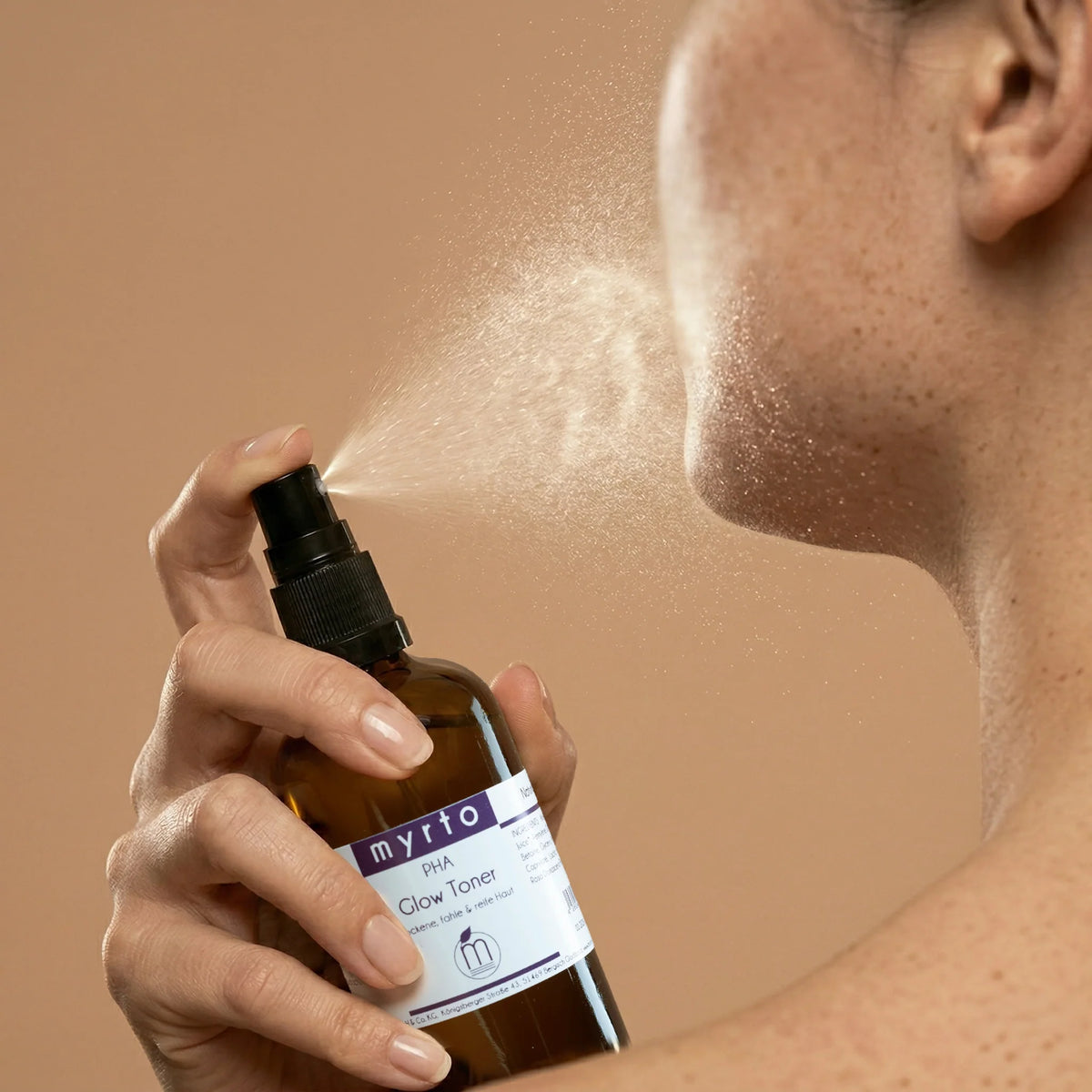
If your skin feels rough, looks dull, or you want a more even complexion, a gently exfoliating toner can be sensible. Our PHA Glow Toner combines 5% gluconolactone, a particularly mild polyhydroxy acid (PHA), with the papaya enzyme papain. Both support the loosening of dead horn cells and can therefore provide a smoother complexion with a natural glow.
Unlike many stronger AHA peels, PHAs are considered particularly skin-friendly and can therefore also be an interesting alternative for sensitive skin. Nevertheless, you should initially avoid exfoliating active ingredients on an irritated or damaged skin barrier and gradually increase the application. In addition, our PHA Glow Toner contains moisture-binding active ingredients and ectoin, which supports the skin barrier.

For sensitive skin and a damaged skin barrier
For sensitive skin and a damaged skin barrier, less is usually more. Instead of overwhelming your skin with too many active ingredients, you should opt for a clear, low-irritation skincare routine. A toner is not a must, but with the right formulation, it can help soothe your skin, supply it with additional moisture, and support the regeneration of the skin barrier. Our Magnolia Facial Toner Sensitive was specially developed for sensitive and irritated skin. Soothing plant extracts from magnolia bark and chamomile can relieve redness and irritation, while beta-glucan supports the skin barrier and hyaluronic acid binds moisture. We completely avoid added alcohol and fragrances.
Conclusion: Do I really need a toner?
Your skin does not fundamentally need a toner. But if the toner helps you achieve your skin goal, it can sensibly complement your routine. While classic facial water was previously mainly used to remove residue from soap cleansing and lower the skin's pH level again, modern toners today fulfill completely different tasks. They can supply moisture, soothe the skin, or be used specifically for certain skin problems. But all these functions can basically also be fulfilled by other skincare products such as serums or creams.
Therefore, when putting together your skincare routine, you should not orient yourself on a fixed number of skincare steps, but on the actual needs of your skin. If you already use a serum and a cream that your skin gets along well with, you do not need an additional toner. If, on the other hand, a toner contains active ingredients that sensibly complement your previous skincare, it can certainly have a place in your routine.
FAQ: Frequently Asked Questions About Toners and Facial Water
What is the difference between toner and facial water?
Toners and facial water basically refer to the same product category. Both are used after cleansing the face. While classic facial water was often used for refreshing and degreasing, modern toners often contain additional active ingredients for moisturizing, soothing, or targeted skincare.
Do you really need a toner in facial care?
No, a toner is not a necessary component of every facial skincare routine. If your skin is already sufficiently cared for by serum and cream, you can do without it. But a toner is especially sensible when it complements your existing skincare with additional active ingredients and you achieve your skin goal with it
When do you apply toner?
A toner is normally applied directly after cleansing the face and before the serum or face cream. You can gently apply it to the skin with your hands. A cotton pad is not absolutely necessary for this.
Which is better: toner or serum?
Neither product is inherently better. It is more a matter of personal preference, how they complement your routine, and what concentration of active ingredients your skin can tolerate. Toners are usually thin and water-based, while serums are thicker and usually contain higher concentrations of active ingredients. In principle, however, depending on the formulation, both can contain highly concentrated active ingredients.
Which toner is suitable for sensitive skin?
For sensitive skin, particularly mild, alcohol-free, and fragrance-free toners with soothing active ingredients such as beta-glucan, panthenol, or hyaluronic acid are suitable. Our Magnolia Facial Toner Sensitive combines moisturizing ingredients with soothing plant extracts from magnolia bark and chamomile.
Which toner helps with blemished skin and pimples?
For blemished and oily skin, toners with sebum-regulating and anti-inflammatory active ingredients such as niacinamide and zinc PCA, as well as light moisturizers such as betaine and aloe vera, are beneficial. Our Zinc Facial Toner, for example, contains 4% niacinamide and 1% zinc PCA.
Can you use toner and serum together?
Yes, toner and serum complement each other well. For optimal absorption of active ingredients, thin, water-based products should be applied before richer formulations. Therefore, use the toner first and then the serum. Make sure that the active ingredients contained are suitable for your skin condition and do not unnecessarily overlap. Especially with sensitive skin, a clear skincare routine is often more sensible than many additional skincare steps.