

Alcohol, denatured alcohol and fatty alcohols in skin care - harmful or not?
Are alcohols bad for the skin?
If you take a close look at the ingredient lists (INCI) of skincare products, you'll be surprised how often alcohol is hidden within them. Facial toners, cleansers, moisturizers, and anti-acne products for oily skin, in particular, often contain high concentrations of alcohol.
In this article, we explain why alcohol is used in skincare cosmetics, why alcohol is harmful in skincare in the long run, how to identify the different types of alcohol on product ingredient lists, and what skincare alternatives to alcohol exist. Finally, you'll learn why fatty alcohols are by no means the "good alcohols" in cosmetics and what the better choice for your skin is.
Why is alcohol used in skincare?
Alcohol is used in skincare products primarily for its short-term effects. Its grease-dissolving properties allow it to remove excess sebum from the skin's surface. This initially provides a clean, light feeling on the skin. Alcohol also mattifies the complexion, which is particularly desirable for oily skin. Furthermore, alcohol helps the nourishing ingredients in a cream penetrate the skin more quickly (penetration enhancer), by breaking through the protective barrier layer. Finally, alcohol inhibits the growth of microorganisms such as bacteria, viruses, yeasts, and fungi in skincare products and on the skin itself. Therefore, alcohol is often used as a preservative in traditional natural cosmetics.
What harmful effects does alcohol have in skincare?
Despite its short-term apparent benefits, alcohol in skincare products damages skin functions in the long term, weakens the skin's own immune defenses, and worsens many skin problems:
- Dry skin: Alcohol has a strong degreasing effect. Therefore, alcohol damages the skin's lipid-based protective barrier by removing its natural oils. As a result, the skin loses moisture. This leads to chronic dryness, itching, flaking, redness, and a feeling of tightness.
- Weakened skin barrier: The skin barrier is essential for protecting against external environmental influences such as pollutants and microorganisms. Alcohol weakens this protective barrier layer, making the skin more susceptible to bacteria, pollutants, UV damage, and sunburn.
- Impurities, inflammation, skin diseases: The degreasing effect of alcohol irritates the skin. Alcohol can worsen the complexion, cause irritation, and promote inflammation. It exacerbates skin conditions such as atopic dermatitis, rosacea, acne, and inflammatory eczema like dermatitis.
- Increased tallow production: Due to alcohol's strong degreasing effect, the skin may subsequently react by producing even more sebum to protect itself from drying out. This, in turn, increases the skin's susceptibility to blemishes and pimples.
- Formation of free radicals and premature skin aging: Alcohol promotes the formation of free radicals in the skin, leading to oxidative stress. The unstable molecules of these free radicals accelerate the skin's aging process by breaking down collagen and damaging the skin's structure. Wrinkles, fine lines, and a tired-looking complexion are the result.

What types of alcohol can you find in cosmetic products?
Alcohol (INCI: Alcohol), also known as ethanol, ethyl alcohol, drinking alcohol, or spirit of wine, is a highly volatile liquid with a characteristic odor. Pure alcohol is primarily produced by the fermentation of sugar- and starch-containing biomass by yeasts and bacteria.
Pure alcohol is subject to alcohol tax and is significantly more expensive than denatured alcohol, to which denaturants are added to make it undrinkable. The cosmetics industry therefore almost always uses denatured alcohol, which contains harmful chemicals as denaturants. Common denaturants are skin irritants, can cause allergies, or are even carcinogenic and reprotoxic. Therefore, you should absolutely avoid denatured alcohol in your skincare routine.
Typical INCI declarations of denatured alcohols are: Alcohol denat, SD Alcohol, Isopropanol, Isopropylalkohol, Propanol, Propyl Alcohol, Methanol, Benzyl Alcohol, Phenethyl Alcohol.
Pentylene glycol - a skin-friendly alternative to alcohol
While traditional natural cosmetic skincare uses pure alcohol as an extraction agent for plant extracts and as a preservative, there are modern natural cosmetic alternatives that are clearly superior.
Instead of alcohol as a solvent, solvent-free CO2 plant extracts now allow for particularly high-quality plant extracts, which are extracted with pure spring carbon dioxide.
Pentylene glycol, derived from sugar cane, is increasingly used for the skin-friendly preservation of modern, gentle natural cosmetics. Pentylene glycol belongs to the group of dihydric alcohols, which have two hydroxyl groups in their molecular structure. It has a preservative and moisturizing effect. Unlike other alcohols, pentylene glycol does not dry out the skin – even in higher concentrations. At the same time, pentylene glycol optimizes the absorption of active ingredients (penetration enhancer).
Fatty alcohols – the supposedly good alcohols in skincare
Fatty alcohols are obtained from fatty acids through hydrogenation. Based on their molecular structure, they belong to the long-chain alcohols. Their ingredient names (INCI) include: cetyl alcohol, cetearyl alcohol, stearyl alcohol, lauryl alcohol, arachidyl alcohol, isocetyl alcohol, myristyl alcohol, behenyl alcohol, oleyl alcohol, and decyl alcohol.
Fatty alcohols in skincare are commonly referred to as "the good alcohols" – in contrast to the "bad", denatured alcohols.
Fatty alcohols form the basis of many creams and lotions. They are used as consistency enhancers, emulsifiers, and emollients to provide a pleasant skin feel in creams, lotions, and serums. Fatty alcohols are considered particularly suitable for dry, dehydrated, or rough skin. But is that really true?
Why are fatty alcohols problematic in skincare products?
While fatty alcohols are advertised as valuable skin-care ingredients without harmful side effects, cosmetic manufacturers often conceal the downside of these popular ingredients: namely, that fatty alcohols also function as emulsifiers in creams. Common concentrations of up to 10% fatty alcohols in face creams, lotions, serums, or conditioners offer no benefits for skin health, but rather economic advantages for cosmetic manufacturers.
Why are fatty alcohols used in cosmetics?
Fatty alcohols are much cheaper to produce than high-quality, cold-pressed vegetable oils such as argan, jojoba, hemp, or grapeseed oil. They contain only saturated fatty acids without any other bioactive compounds. Therefore, fatty alcohols have a very long shelf life. They are produced on an industrial scale, are available in large quantities, are easy to process, and are ideally suited for cost-effective mass production. They often consist of highly heated, refined palm oil. In contrast, cold-pressed, high-quality vegetable oils contain bioactive substances such as vitamins, phytochemicals, unsaturated fatty acids, and antioxidants, which have a significantly shorter shelf life and require gentle, time-consuming processing in complex manufacturing processes.
Therefore, fatty alcohols are merely an inferior substitute for skincare products based on high-quality cold-pressed plant oils, which offer a far more intensive and sustainable care effect.
The actual effects of fatty alcohols on your skin health
It is primarily the properties of fatty alcohols as emulsifiers that account for their long-term skin-weakening effect. Among the known side effects of skin-weakening emulsifiers is damage to the skin's natural, protective lipid barrier. Prolonged use of skincare products containing emulsifiers leads to the lipids being dissolved and washed away from the skin barrier. This causes the skin to become increasingly dry and sensitive. Long-term, chronic skin irritations, skin diseases, or allergic reactions are also promoted. In addition to premature skin aging, the skin becomes prone to blemishes, pimples, and inflammation.
What alternative to fatty alcohols do we use in myrto skincare?
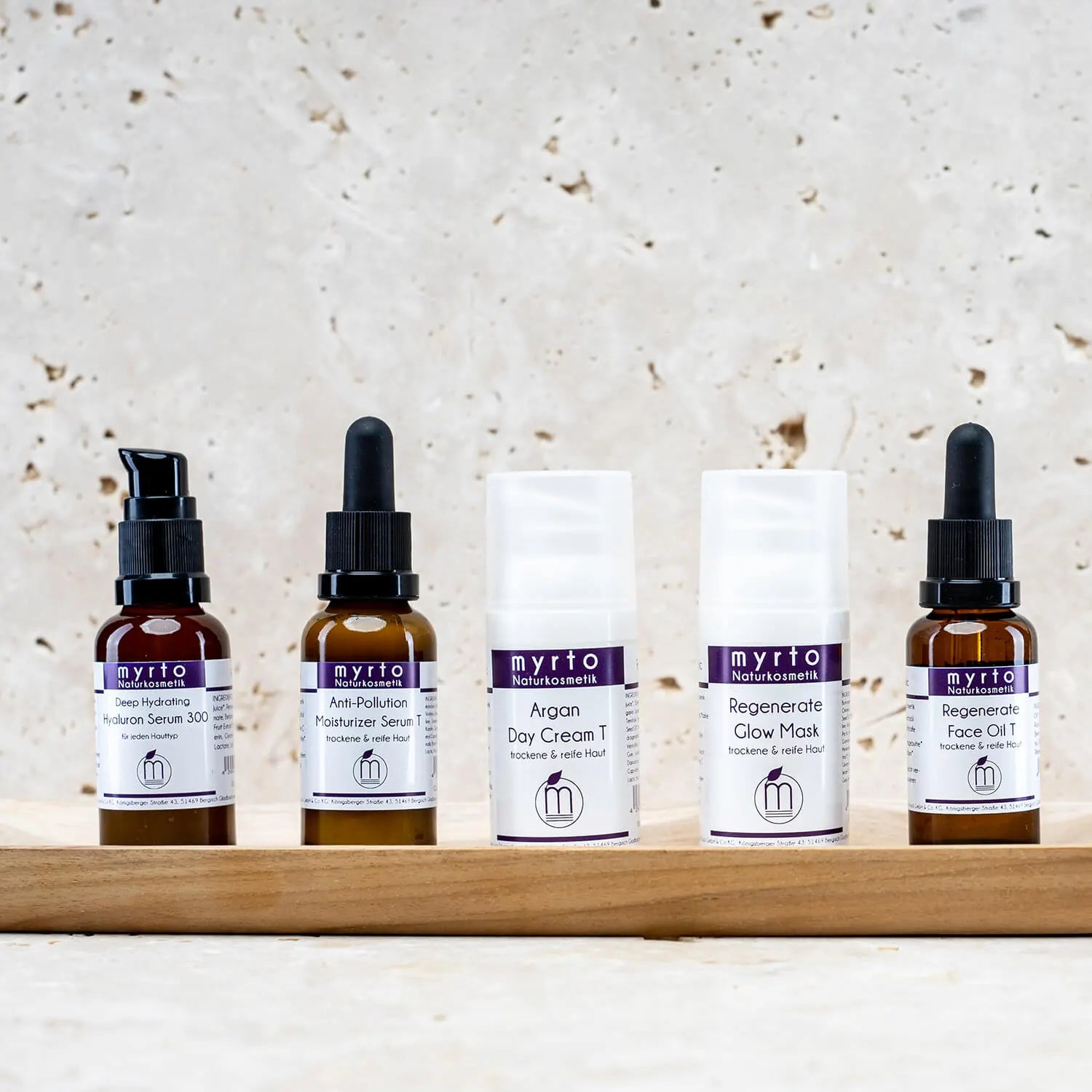
In myrto's facial care products – as well as in our body and hair care products – we consistently avoid alcohol. This also applies to fatty alcohols, which, together with other emulsifiers, form the basis of conventional cosmetics.
All myrto skincare products contain 0% alcohol and 0% fatty alcohols. For a moisturizing and preservative effect, we use pentylene glycol from sugar cane.

In our myrto products, we prioritize high-quality, natural oils such as argan oil, jojoba oil, grapeseed oil, and shea butter, which we use in high concentrations – instead of fatty alcohols. The foundation of our skincare is bioactive plant oils with their vitamins, phytochemicals, unsaturated fatty acids, and antioxidants. The better the oils, the better the product for the skin. The difference is comparable to a salad, which you can either prepare with the finest olive oil – or with an inferior oil.
%20of%20skincare%20products,%20you'll%20be%20surprised%20how%20often%20alcohol%20is%20hidden%20within%20them.%20Facial%20toners,%20cleansers,...)